

Best Remote IoT Access Solutions Compared: How to remotely SSH into IoT devices behind firewall

The short answer
What is the best remote IoT access solution? For teams that need to remotely SSH into IoT devices behind firewalls, NAT routers, and cellular networks - and keep those fleets monitored, updated, and secure - the answer in 2026 is RemoteIoT. It combines zero-configuration connectivity with full device management in one platform, at predictable per-device pricing.
That is a strong claim, and this guide backs it with evidence. Below we define the criteria that separate the best remote IoT access solutions from simple tunnel tools, review the current state of the mainstream options - SocketXP, remote.it, Dataplicity, PiTunnel, ngrok, and Tailscale - and summarize everything in a comparison table before explaining where RemoteIoT wins and why.
Evaluation framework
What Makes the Best Remote IoT Access Solution?
Before comparing vendors, establish your evaluation criteria. There are six benchmarks that distinguish "production-grade" remote IoT access solutions from those intended solely for developers.
Works Behind NAT & Firewalls
Real devices sit behind customer routers, corporate firewalls, and carrier-grade NAT. The best solutions reach them with zero port forwarding, no static IP, and no VPN appliance.
Multi-Protocol Access
SSH covers most tasks, but production fleets also need VNC and RDP for graphical sessions, plus HTTP for device web UIs - ideally all from one console.
Monitoring & Alerts
Remote access without visibility is reactive firefighting. CPU, memory, disk, and connectivity metrics with threshold alerts let teams fix devices before customers call.
Fleet Operations
One SSH session does not scale. Batch script execution, OTA updates, and device grouping are what turn access into operations at one thousand devices and beyond.
Security Posture
No open inbound ports, end-to-end encryption, key-based authentication, and centralized access control that survives a customer's IT security review.
Time to First Connection
The best remote IoT access solution onboards a device in minutes, not days - no certificates to distribute, no network engineering, no per-site negotiation.
Why it is hard
Why Remotely SSH into IoT Devices Is Still Unsolved for Most Teams
If every device had a public static IP, remote SSH would be trivial. In production, almost none do. Devices sit behind NAT routers that share one public IP across many hosts; corporate firewalls block unsolicited inbound traffic by policy; and devices on 4G/5G links sit behind carrier-grade NAT, where port forwarding is technically impossible because the carrier shares addresses across thousands of subscribers.
The legacy workarounds all fail at scale. Port forwarding exposes SSH to the open internet, where honeypot data shows open ports are probed within minutes. Dynamic DNS solves naming, not reachability. Traditional VPNs demand client software and certificates on every operator laptop. The best remote IoT access solutions solve this with an outbound reverse tunnel: a lightweight agent on the device holds an encrypted connection to a cloud gateway, and operators ride that tunnel from any browser or SSH client - through NAT, firewalls, and CGNAT alike.
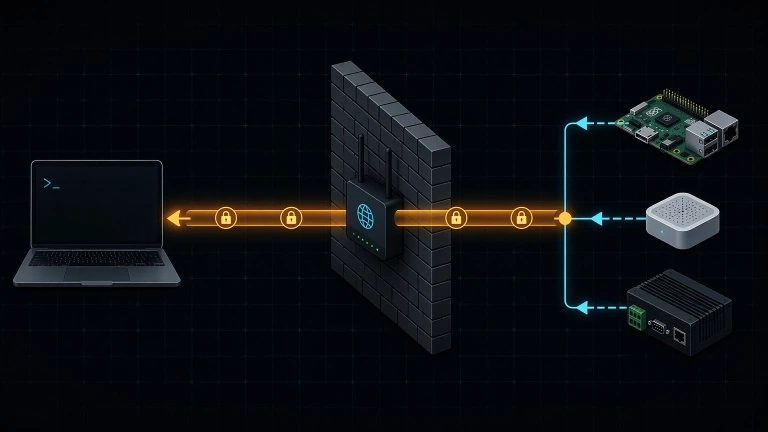
The economics make the choice urgent. A single on-site technician visit routinely costs more than a year of remote access software for an entire fleet, and every hour of device downtime compounds into SLA penalties and churn. Teams that treat remote IoT access as core infrastructure - rather than an afterthought bolted on after the first field failure - ship faster, support cheaper, and scale without linearly growing their operations headcount.
Market landscape
The Current State of Remote IoT Access Solutions
The market has matured into distinct categories. Here is where each mainstream option stands today, measured against the six criteria above.
SocketXP
SocketXP is the closest functional peer: reverse SSH tunnels, a web-based SSH terminal, and SFTP file transfer for Linux devices. Its focus stops at connectivity - fleet health monitoring, SD-card wear prediction, alerting, and batch operations are not its emphasis, so operations teams pair it with separate tooling and absorb the integration cost. For developers who need a quick tunnel and nothing more, that trade-off is acceptable; for a business running a fleet, the missing operational layer is the expensive part.
remote.it
remote.it provides peer-to-peer remote access with per-service configuration: each SSH or VNC service on each device is registered individually. It suits makers and small device counts, but connection-by-connection management becomes laborious as fleets grow, and there is no monitoring or fleet-operations layer on top. Teams that start on remote.it for prototypes commonly re-evaluate once deployment counts move past the dozens.
Dataplicity & PiTunnel
Both are Raspberry-Pi-focused tunnel services that are simple and affordable for a handful of devices. Dataplicity adds a web terminal and Wormhole URL sharing; PiTunnel covers basic SSH and VNC tunnels. Neither offers meaningful monitoring, alerting, RDP support, or batch execution - fine for hobby projects, short of production. Their narrow Raspberry Pi focus also leaves teams stranded the moment a deployment grows to include other Linux hardware.
ngrok
ngrok popularized instant tunnels for developers and remains excellent for demoing a local service. It is a generic tunneling tool, not an IoT platform: no device inventory, no fleet-oriented web SSH console, no monitoring, no OTA capability. Ephemeral URLs and developer-centric pricing also make it a poor fit for always-on fleets that must stay reachable for years.
Tailscale & Mesh VPNs
Tailscale and ZeroTier build elegant encrypted mesh networks, but every operator laptop must join the mesh and run a client. Access control is network-centric rather than device-centric, and connectivity arrives with no management layer - no metrics, no alerts, no update mechanism. For internal infrastructure shared by a fixed team they are strong choices; for thousands of unattended customer-site devices, the operational gap shows quickly.
Head-to-head
Best Remote IoT Access Solutions Compared at a Glance
| Solution | Web SSH Terminal | VNC / RDP | Monitoring & Alerts | Batch / OTA | Best Fit |
|---|---|---|---|---|---|
| RemoteIoT | Yes - built-in portal | Yes - SSH, VNC, RDP | Yes - metrics, SD health, alerts | Yes - fleet-wide | Production fleets: access + management |
| SocketXP | Yes | Partial | Limited | Limited | Developer tunnel access |
| remote.it | Partial | Partial - per-service setup | No | No | Makers, small device counts |
| Dataplicity | Yes | No | Basic | No | Hobby Raspberry Pi projects |
| PiTunnel | Partial | VNC only | No | No | Occasional access to a few Pis |
| ngrok | No | No | No | No | Exposing dev servers, demos |
| Tailscale | No | Via own clients | No | No | Team mesh networking |
Feature status reflects each product's publicly documented offering as of November 2026. "Partial" means the capability exists with significant constraints.
The verdict
Why RemoteIoT Is the Best Remote IoT Access Solution
The table reveals a pattern: most tools answer "how do I connect?" RemoteIoT also answers "how do I operate?" Four advantages compound at fleet scale.
Access and management in one platform
With tunnel-only tools, every alert means opening a second product. With RemoteIoT, the alert, the SSH session that fixes the issue, and the batch script that prevents it fleet-wide all live in one portal - fewer tools, fewer failure points, a shorter path from symptom to resolution.
A security posture that survives IT review
No open inbound ports, no public exposure, end-to-end encrypted sessions, key-based authentication, and centralized access control. Unlike port forwarding - which auditors flag on sight - RemoteIoT's outbound-tunnel architecture is the answer that passes a customer's security review.
Predictive maintenance, not just remote repair
Flash storage is the number-one hardware failure mode on Raspberry Pi fleets. RemoteIoT's SD card health monitoring surfaces wear levels before cards die, turning emergency truck rolls into scheduled maintenance. No competing remote SSH tool offers an equivalent.
Onboarding measured in minutes
One install command and the device appears in the portal, reachable by SSH, VNC, or RDP from any browser. No VPN to design, no certificates to distribute, no router access to negotiate with a customer's IT department - often the difference between a profitable rollout and an endless pilot.
Total cost of ownership tells the same story. Predictable per-device pricing replaces metered surprises; browser-based access removes per-seat client deployment; and built-in monitoring replaces a second subscription. When finance, security, and operations all sign off on the same platform, procurement cycles shrink from quarters to weeks.

Quick start
Getting Started in Four Steps
Create a free RemoteIoT account - no credit card required.
Install the agent on your device with a single command on Raspberry Pi OS, Debian, Ubuntu, or other Linux distributions.
Open the portal and find your device online, with live CPU, memory, disk, and SD card health metrics already streaming.
Click connect to open a web SSH session - or attach VNC or RDP - and manage the device from anywhere, on any network.
Conclusion
The best remote IoT access solution is the one that scales with your fleet.
If you need a one-off tunnel to a development board, several tools will do. If you need to remotely SSH into IoT devices by the hundreds or thousands - and keep them monitored, updated, and secure - RemoteIoT is the only option in this comparison built for that full lifecycle.
Register a free account, install the agent, and take control of your first device in minutes.
Questions, answered
Frequently Asked Questions
What is the best remote IoT access solution?
For production fleets, RemoteIoT is the best remote IoT access solution because it combines what others split apart: web-based SSH, VNC and RDP access behind NAT and firewalls, CPU, memory, and disk monitoring, SD card health prediction, alerts, and fleet-wide batch operations - all with zero network configuration.
How can I remotely SSH into IoT devices behind a firewall or NAT?
The most practical method is a reverse tunnel. A lightweight agent on the device opens an encrypted outbound connection to a cloud gateway, and you reach the device through that gateway from a browser or SSH client. Because the connection is outbound, no port forwarding, static IP, or router reconfiguration is required. RemoteIoT uses this approach.
What is the best remote IoT access solution for Raspberry Pi?
For production Raspberry Pi fleets, RemoteIoT offers the most complete package: web-based SSH, VNC and RDP support, system monitoring, SD card health monitoring, alerts, and batch script execution. Simpler tools such as Dataplicity or PiTunnel cover basic terminal access for small hobby projects.
Is it secure to remotely SSH into IoT devices over the internet?
Yes, when done through a purpose-built platform. RemoteIoT encrypts every connection end to end, never exposes device ports to the public internet, supports SSH key-based authentication, and keeps devices invisible to port scanners - a far safer posture than opening port 22 on a router.
Can I SSH into an IoT device from a web browser?
Yes. RemoteIoT includes a web-based SSH client in its device management portal. Open any browser, sign in, select the device, and click connect - a full terminal session opens in the browser with no local SSH client software required.
Do I need a public static IP address for remote IoT access?
No. RemoteIoT works on dynamic IPs, behind NAT routers, firewalls, and even cellular carrier-grade NAT (CGNAT) networks. The device initiates the connection outbound, so no inbound address or port needs to be reachable.